Sunday, June 7, 2009

Chemical Names Of Degreasing Chemicals

StarmapPro for iPhone and iPod touch


I learned of this application for iPhone and iPod touch a week ago. The Pro version of the video was so convincingly, that within a week I bought an iPod touch and the Pro version

Starmap Pro combines the functions of a planetarium, with over 2.5 million stars and the entire NGC and IC catalogs, and Assistant to the observations. In my opinion, has almost nothing in less than desktop applications where the cost is higher than the total cost of software and iPod touch. But there is no small advantage: it's all in the palm of your hand. It's not just the fact that there are more leads on the field computer (with the battery-that frost could also ruin-, table, chairs), or the three volumes of Uranometria, or Sky Atlas, which is so wide open we do not know where to place it. Already these advantages alone are worth the purchase, but there are others.

Last night I tried it at home with a horrible sky. Here are my impressions.

object fits in the palm of your hand. It has the ability to define fields of view finder and different for each telescope eyepieces. Looking at the "thing" you see what you would see in the finder, and while this is the eyepiece of the finder (or telescope). Not to mention the possibility of having the Telrad circles overlap.

born a new way of doing starhopping. Traditionally starhopping you this: you look to the naked eye a path of stars that come close to the object and try to identify the point in the sky where is the object. You point there, perhaps with the help of the circles of the Telrad. It pounta that an empty space at a precise position relative to the stars around. Then you look in the finder and, if the object is not visible, try to put the crosshair in the right place with the help of the stars visible in the field. At this point, very often you have to leave the telescope back to the table where is the computer, save the stars around the object (which often have a completely different scale, orientation and intensity), back to the finder, try to recognize the field of stars and point. It is not unusual that needs to be done fro 2:00 to 3:00.

With the "thing" style changes. You look a star visible to naked eye and is close to the object point. You place that is a point where we see something. Then, with the thing in hand to the eyepiece, you look at the simulated star field around the star (see the first figure) and he is recognized immediately in the field of the finder. At this point you navigate with the finder of star in star, helped by the fact that the cross-roads and the fields are oriented right, follow the navigation in the "thing" and voila, that's got it right. The style is different because instead of making the path to the naked eye and point the direction of the object, you point a star becomes visible and the path to the seeker. The difference is enormous.

You can then take notes (as in figure below). Time and date are automatic. By the way, is also very easy to determine the limit mv (you try and you click the little star in the thing).


Here are my notes from last night (the hole between 00:45 and 01:39 is due to clouds): 06/07/2009 00:44

NGC 6210, 360X, elongated EW, nucleus with feathered edge, UHC 260X less. 06/07/2009 00:45 17.97 SQM
mv 4.3 (at 60 degrees altitude). 06/07/2009 01:39
mv 4.8 (zenith) 18.03 SQM. 06/07/2009 01:50 M92
resolved 86x 172x 260X, pinpoint stars at 172x.


Addendum 09/06/2009

There are two features that deserve to be remembered in especially:

1) Importing objects from SIMBAD database. Starmap has a function "web search". You insert the identifier of an object (eg PK 080-06.1) and the system accesses the database SIMBAD creating a new object (in this example Cygnus Egg) with related data and location. The object can then be found with the usual methods. In practice, you can build a customized list by selecting between 4 and a half million objects in the database. A convenient way to plan the observations is to take the identifiers at the table at home, or by starting from Uranometria Sky Atlas. Using the browser at home you can also see pictures of the object you will see (If you want you can do with Safari from the iPhone, as long as there is coverage).

2) The "path finder" draw a line of junction between the star most appropriate next to the object and the object itself. This line is visible even in simulation mode of the finder or telescope. In practice it's a kind of guide that provides direction to find the object starting from the star. It 's really useful, a TOM TOM sky. You place the star and follow the line to the object.

Wednesday, May 13, 2009

How Tight Should My Motorcycle Brake Calipers Be?

Following in the footsteps of Lacaille

Namibia 20/26 April 2009, Part


Question: what is the largest galaxy visible in the sky cut? You would think ... NGC 253? Or NGC 4565? Wrong, it is quite simply ... the Milky Way!

And 'This is the main impression that you are viewing the sky from the southern hemisphere: the Milky Way is no longer a simple strip of light but becomes a galaxy in all respects. With the swelling of the nucleus reaches the zenith, it seems to have the copy in the giant NGC 4565, which occupies the entire sky, in a charming scene from science fiction movies!


But first things first. In astronomy which celebrates Galileo, a group of five amateurs, including three from Friuli, a Piedmontese and Padua (myself), decided to celebrate in some way going over the leg of another important astronomer, Nicolas Lacaille. He was the first European to study in detail the Sky South Africa in 1700, and again today for all five of us this was the first time below the equator.

The destination was the Guest- Namibia Farm in Tivoli, located 140 km as the crow flies southeast of the capital Windhoek, a specially equipped place for lovers of the sky because it provides a great deal to hire and variety of tools that would otherwise be impossible to transport by air. For visual observations we used both Dobson, 25 and 50 cm opening!


The weather was all in all favorable, considering that this was not the best season yet and is somewhat 'more difficult to achieve perfect conditions encountered between June and August, the first night was calm but there was a slight haze on the horizon was that blur the Milky Way at around 10 ° and the Magellanic Clouds made invisible when it came to the minimum height (from 23 ° S latitude are circumpolar, but when they touch the horizon in lower culmination).

Then came a slight flick of the tail of the rainy season: the second night, the sky is overcast and we went to bed early disconsolate, but fortunately after midnight one of us was still awake (guess who ...) and had the bright idea to look out and see that the sky had opened, so he (or rather, I) woke up the others and all we could take advantage of the second part of the night until dawn. Which by the way was spectacular because the crescent moon was "a boat" in trio with Venus and Mars, and further down the clouds like those seen in documentaries of the savannah, complete with strings of light rain that evaporates before touching the ground!

Here is the picture:


the third night is even arrivato un temporale, ma anche in quel caso il cielo si è discretamente aperto a mezzanotte. Al quarto giorno altro temporale nel pomeriggio e poi cielo sgombro subito dal tramonto, ma questa volta è stata l’umidità pazzesca, dovuta ai postumi della pioggia, a rendere difficoltose le osservazioni, e verso le ore 2 anche l’asciugacapelli si è arreso e abbiamo deciso di smettere.

Le ultime tre notti finalmente sono tornate nelle condizioni ideali, e anche la trasparenza era migliorata perché rispetto alla prima sera la Via Lattea si avvicinava di più all’orizzonte, le Nubi di Magellano rimanevano sempre visibili per tutta la notte e vedevamo stelle di terza magnitudine alte 1°!


The seeing was disappointing: only the first part of the first night was fantastic and we saw a wonderful Saturn, but toward morning, when Jupiter was rising and the Moon, has come a worthy turbulence of the most disgusting evenings Padua. It was a sign of instability in atmospheric arrival.

Even in the days following the departure of the clouds but there were several changes in wind direction that made the situation unstable and therefore the seeing has never really returned to the top. Evidently there is also the rule of inverse correlation between turbulence and extinction! Have been few moments in which they exploited well 500X sulle nebulose planetarie, e sono sicuro che non fosse colpa dello specchio caldo perché se le stelle apparivano come pallettoni di polistirolo, lo rimanevano anche a fine nottata.

Io spero solo di aver trovato una settimana sfortunata su questo fronte, perché l’altopiano della Namibia dovrebbe avere le carte in regola per dare mediamente molto di più. In ogni caso il seeing è molto difficile da valutare e soprattutto da raccontare, e non potremo fare confronti precisi tra siti e serate diverse finché non inventeranno uno strumento semplice, veloce e oggettivo per misurarlo, come fortunatamente fa l’SQM per il livello di buio.


Arriviamo dunque al punto più interessante della faccenda: la qualità del cielo. E anche qui le sorprese non sono mancate. Ovviamente l’inquinamento luminoso è assente, e così finalmente ho potuto capire com’è fatto un cielo incontaminato e che effetto hanno i soli elementi di luce naturale.

Alla sera si vedeva la luce zodiacale, bassa in Toro e Gemelli, che si incrociava con la Via Lattea, mentre verso mattina era più imponente perché l’eclittica nell’Acquario era perpendicolare all’orizzonte.

Appariva più o meno come in questa foto:

http://apod.nasa.gov/apod/ap090212.html

not end there because there was balance between Spica and the Gegenschein, and the best nights (below describe the changes and issues) you could see the zodiacal light along the ecliptic too! It was clear that the range of Leo and Virgo were clearer than in the parts of Hydra, top, and Pastor / Chioma, below.

Then there's the airglow, as expected, becomes brighter as it approaches the horizon as you look through a thicker layer of atmosphere and then there is a greater number of air molecules emit luminescence. This is, however, up to about 5 ° high, because at that point is the extinction to prevail and the speech is reversed, with the band from 5 ° to 0 ° appearing darker. It 'so good to know that even a pristine sky has different gradients of light. All Natural!

But apart from the effect damn nice to have the dark horizon in 99% of the directions (I say 99 because NW is a small speck of Windhoek. It 'is insignificant and not sufficient to generate pollution, however, note) I have not found, fortunately, other differences compared to our abysmal skies of the mountains, as had been heralded by all those who had gone into the desert before. This probably because they were not used to the skies of 21.6 like me.


The real difference between the sky of Namibia and our best sites is therefore not the darkness itself, but is due to the constellations! In fact, the northern sky, with poor Leone as a dead fish floating upside down, there appeared insignificant in comparison to the uproar of stuff that you could see the other side: the area that includes the constellation of Hull, Cross, Centaurus Wolf and Scorpion there is a high concentration of bright stars, so that only the area of \u200b\u200bOrion and Taurus can compete. Ma le costellazioni di prima, oltre a essere molto luminose, sono anche sovrapposte alla meravigliosa e brillantissima Via Lattea australe, che è indubbiamente migliore di quella boreale non solo perché c’è il rigonfiamento del nucleo (che ha uno spessore di oltre 50°!), ma anche perché presenta contrasti molto forti tra nubi chiare e nubi oscure. La Via Lattea “nostra” invece è più diafana e sbiadita: del ramo invernale non ne pariamo neppure, ma perfino il Cigno è stato bastonato dal Centauro, quando verso mattina si vedevano entrambi alla stessa altezza agli antipodi del cielo.

E, come se non bastasse, a completare il quadretto del sud si aggiungono pure le Nubi di Magellano! Prima I read that leaving the amateur Australian experience a sensation of "empty sky" if they go in the northern hemisphere, and now I understand perfectly what they mean.

a monster catching graphics Starry Night, that reproduces in the best possible way (unfortunately I do not know a way to put BN in the Milky Way, leaving the colored stars) the naked eye in the sky which is visible from the latitude to April shortly after midnight.


But back to talk about SQM. Given that you could not use the second part of the night when he went to the Sagittarius zenith, the readings also made away from the Milky Way were a bit 'lower expectations. I thought hard to find 21.9, as I knew to be a pure sky, but we had mean values \u200b\u200baround 21.7. At first not well understood why, because if a non-polluted sky is not entirely clear, in case it should be darker than a perfect and clear. Then we realized that the "fault" was the Milky Way, whose light is diffused in the rest of the air from the atmosphere, just like it does with the Sun and the Moon!

And the humidity level determines the amount of this distribution: the night was the sixth best on Saturday, 25 where we finally reached the fateful 21.9. Even then, however, the maximum darkness lasted only a couple of hours (from 21 to 23), because as he got up Scorpio readings goes down slightly, despite continued to point the instrument to always Hydra / Virgin. This fact confirms the theory.

Needless to say, the brightness of the Milky Way has an effect on the ground: do not even need to adapt to total darkness in order to distinguish good people, telescopes, accessories on the table and walk in the path (made of dark sand, high-contrast with the grass that is clear) without a battery. The torch was necessary only in the apartments, where there are trees.

I also checked the visibility of the shadow of the Milky Way, putting a hand in front of a white sheet, and towards morning the same conversation with Venus. In the first case of course the shadow had faded in the second net.


The darkness comes true if the sky is covered: the third night, as we were finishing up the cover with the Dobson giant tarpaulin to protect them from the imminent storm, came a black cloud of fear, I measured and came out 22.85! There really was almost like being in a dark room and you could not see almost nothing, I did hardly any impression that scene the night sky!

remember, however, also Casera Razzo, when last summer we found a couple of evenings very unfortunate, the clouds were darker than the clear sky, though did not reach the same levels of darkness (22.0), but this fact is always incredible to those accustomed only to polluted skies.

C ol the peaceful little I have said that the difference is even more subtle, and the best nights of the best sites yet Italians fail to ra com pete with the conditions of Namibia, more As one might expect. And this is a very encouraging news. Said other words, even without pollution light is not obvious to find the perfect conditions, for up to 21.5 in artificial light is no longer the main factor that determines the quality of the air but are the natural ones to "control".


final word on the instruments: I liked very much! The fluidity of movement is perfect, the seekers are comfortable and even the optics seem very good. The course is equipped with 50 cm wide and 25 has a chair with adjustable height. early mirrors were very dusty but the owner gave us the distilled water to wash them. The collimation is easily done, just bring home the laser or Cheshire.

In the next describe in detail the episodes that I observed celestial objects, they are more than 450 even if there is a "trick" because thirty are in the small cloud and about 120 in the large!

close with a small photo gallery . I should point out that no picture is mine (I did not need to take away the camera and I had 11 kg of hand luggage!), It's all about their colleagues and when they have completed the development work will also release the astronomical photos and those already submitted on this page with higher resolution.

Friday, April 17, 2009

Sbi Power Of Attorney Formhome Loan

Measuring the quality of the air with a digital SLR. Because the IL


I bought a Canon EOS 1000D with EF-S 18-55 and I immediately thought of sperficiale try to measure the magnitude of the sky using the camera. The method I described it in this post and some below.
Before now I had a compact digital camera with a small CCD and limitations of sensitivity, which did not allow me to measure over 20.-20.5. The EOS 1000D with its large CMOS sensor is more sensitive and can easily reach 23 and go.
The photograph (click to enlarge) I took it back home with the manual setting: ISO1600, 30, F3, 5. I have cleared the elaborations that increase the contrast, sharpness, color saturation, and I set the temperature color day.
You see the Big Dipper. orgiginale Pictured are visible stars of about magnitude 8.
reading levels of intensity on the picture (with any utility) is in the somewhat 'brighter near the Big Dipper R = 128, G = B = 72 and 61 that correspond to surface magnitude 18.99 (in red) 19.97 (in green) and 20.23 (in blue). The SQM
at that moment I gave readings around 19:01 to 19:05 (I have a sky of 19, 5 + mv, behind the house, which would make the happiness of so many amateur astronomers sedentary, but not mine). The direct comparison can not be done strictly speaking, because the scale R, G, B and SQM photometric scales are different (different spectral sensitivity). The maximum sensitivity of the SQM is around 500-600 nm (see article Cinzano ) then somehow reading the SQM should be compared with R and G. If we take the average of R and G leaves 21:48, which would be compared with the SQM that says 21.03. There are about 4 tenths of a difference, on which I propose to investigate.
Whatever happens, the result is good and, above all, the photograph provides more information. For example tells us that the bulk of the IL is already in the red and green there is a magnitude more (and in fact with the deep sky filter visually improve the situation). We also notice slight irregularities of the bottom polluted. In a previous photo on the recognition of the glazes.
One thing I like to do is a time-lapse fork that points to the Casera Razzo Friuli, during the night to see how you change the IL. We'll see ...

For those wishing to use the same method, following this link you can download an Excel spreadsheet where you can set the parameters of the camera's exposure and the levels read on photography. The paper calculates the magnitude and the surface also shows in a chart.
The spreadsheet assumes that photography is encoded in the sRGB color space (some fotocasmere allow you to choose more than one color space: Choose this).

http://rapidshare.com/files/222586514/misure_digicam_v3.xls.html


Addendum.

I delete the background sky (by cutting up to those levels of light pollution) and is a nice photo with stars up to magnitude 7 (click to enlarge). Too bad it's a trick.

Sunday, February 15, 2009

Replacing Mortar In Rock Retaining Walls

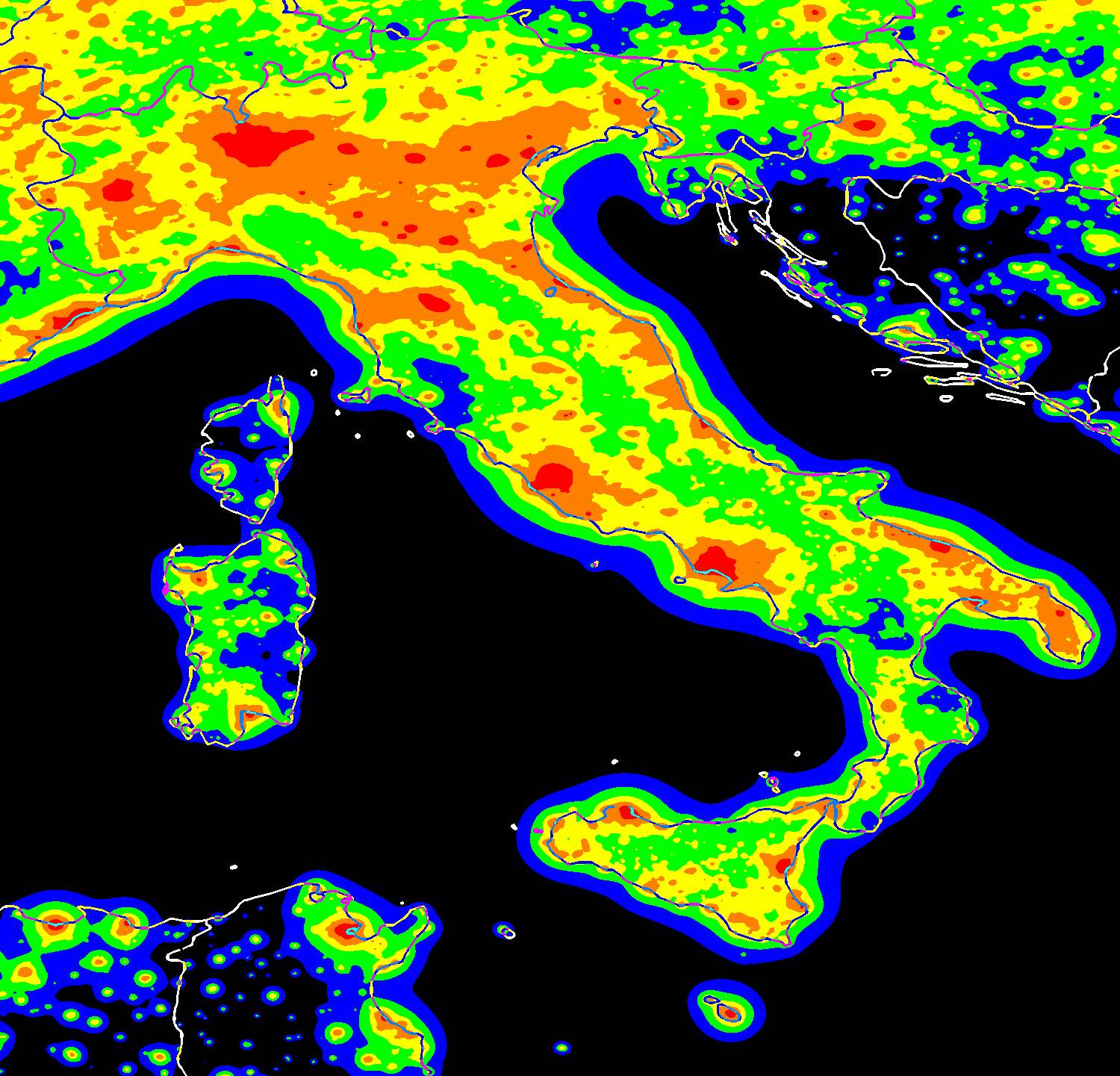
pollution Italian is superior? Statistics

Apart from the speeches on the scale of bortle already mentioned in earlier that can not be applied in our country, especially for the simple fact that an expert observer of stars viariabili can see differences of about 0.1 magnitude the stars, I would spend two words on the difference of light pollution in countries like France Germany Spain and of course use.

E 'possible to ascertain done with the last article of the February issue of Sky & Telescope Tony Flanders, among other things, this is a podcast:

http://www.skyandtelescope.com/urbanobserving

better understand why there a sky darker.

What immediately struck me more than anything was the performance with the draft as you see here of M31 in a telescope. The drawings are, respectively, from a hypothetical red zone, and even from the white area. The first thing that I was very suspicious is that they seem exaggerated or sottistimati, in the sense that it appears in the red zone, M31 seems to me more of a play for us from an observation area in yellow and that of the white area for us as it relates to an orange zone. Possible that the evaluation of the light pollution of cities is so different from ours?
do not need anyone to tell us milano clarification on what he sees from its center or around what is already in an area orange M31 is completely invisible except with the aid of binoculars.

What causes all this difference? That we can once again (I am referring to a political economic social comparison with other countries) we are always the losers? Reading the article carefully you can see the key points that help to better assess, for example with this sentence: population is 75% of ITS concetrated in a dozen metropolitan areas. If the country's population Were spread uniformly, the whole map
Would Probably the yellow colored

(75% of its population is concentrated in a dozen metropolitan areas. If the population in the country was evenly spread, the entire map would probably be colored yellow)

End of proof where the population is concentrated evenly from us? In the Po Valley of course! Another reality all Italian ...

http://www.lightpollution.it/download/itamini.jpg

What is the difference?
They will suffer large red or white areas but have in periferie di altrettante zone enormi grigie e blu mentre c'è da dire che le zone verdi essendo periferiche sono molto più circoscritte; noi invece abbiamo giallo ovunque e qualche piccola area verde, non contando il paio di uniche blu minuscole. 
Ancora una volta quindi abbiamo la situazione peggiore ingigantita pure da una cattiva gestione dell'illuminazione dedita esclusivamente allo spreco.

Nelle tecniche di osservazione nell'articolo cita benissimoche meglio è osservare dalle 23 in poi in quanto le persone SPENGONO le luci dei giardini e delle proprietà mentre da noi non solo sono accese tutta la notte ma vengono accese molto prima che diventi buio e spente molto dopo che c'è già luce al mattino!
Tra l'altro you just need to see legislation that requires hotels to keep emergency lights lit on each balcony and lights
course in the garden or parking.
phrases enough to define a reality that is all-Italian dedicated to the waste and the waste of energy and demonstrate that the battle
light pollution is just pure utopia, I would say more dedicated to the sale of lighting equipment, with the excuse that they are under and obviously more expensive. Another caste in the lighting industry in fact. Another fundamental

typical situation that we have not assoulutamente is the ability to observe nights free of moisture which leads to an increase of skyglow just happened and where we are becoming increasingly rare nights terse and transparent since the average humidity down to 60-70% at best. (Remember that in Namibia the humidity is only 8%)

then conclude with a gem

Always on the number of Sky & Telescope but this time in January, she read this sentence on page. 85:

Globe at Night (from which the initiative) will be Held from March 16-28, Which overlaps the international Earth Hour "lights out"!

More information here: http://www.globe.gov/GaN/

Once again we are taken for a ride! Si proprio così, visto che all'iniziativa aderiscono ben 62 Paesi!! Mentre da noi ci dannno il contentino con un iniziativa tipo M'illumino di meno tra l'altro TUTTA ITALIANA e pure totalmente inutile in quanto partita con il 13 febbraio che significa in presenza di luna piena o poco meno.

Un'altro schifo che devo riportare quindi vista invece la lodevole iniziativa di  Globe at Night di spegnere le luci sotto luna calante e luna nuova, in modo veramente così da apprezzare come giusto che sia il firmamento.

Adesso non so voi ma tra l'altro vi riporto cosa hanno spento da me nella zona dove abito, ovvero un bel nulla!

Sono le 18.40 e da casa mia non vedo spento nothing
the usual football pitch is on, inter alia, always turning the very first (14.00) to become warm because the bulbs will go off in time after midnight, near the park is on as usual at this time although there none (the boys end up playing after sunset) with automatic shut off at dawn, the greenhouse of the town in front of me had their headlights on to illuminate the block where obviously have ceased to work and stays on all night for fear of thieves , although the cemetery is closed off completely illuminated by sunrise he thieves for fear of satanic cults, tombs or whatever ... What off? hard to say maybe a church or monument lost in the middle of the city. Certainly not a couple more
I only regret that it could not consider whether tonight are on the ski slopes, but they are certainly brave for night owls, subject to there ...

Purpose dell'inziativa M'illumino Less:
join too citizen turning off the lights so we can illuminate the most beautiful squares in Italy!